The Mobility Package from 1 July 2026: A Complete Guide and FAQ for Light Commercial Vehicle Transport (2.5–3.5 t GVW)
Adam Jeziorek | Paweł Kempa | Zuzanna Malek
Published 24.07.2026
9 min reading time

The European transport industry is facing one of the most significant structural reforms of recent decades. On 1 July 2026, a key phase of the EU Mobility Package came into force. These regulations are transforming the light commercial vehicle (LCV) sector, commonly referred to as vans.
Until now, international transport carried out with vehicles weighing up to 3.5 tonnes Gross Vehicle Weight (GVW) enjoyed considerable flexibility and relatively limited administrative requirements. As of July 2026, this situation has fundamentally changed. The EU legislator has aligned many aspects of light commercial transport with those applicable to heavy goods vehicles (HGVs) exceeding 3.5 tonnes.
For companies operating in the transport, forwarding, and logistics (TSL) sector, this means the immediate implementation of compliance procedures. This guide provides a detailed overview of the new regulations based on official guidance from the European Commission, the Polish Road Transport Inspectorate (GITD), and analyses from leading legal experts.
Table of Contents
Scope of Application: Who Is Affected by the Mobility Package from 1 July 2026?
Which Vehicles Are Covered by the New Mobility Package Regulations?
The new rules apply to motor vehicles or vehicle combinations (e.g., a van and trailer) with a GVW between 2.5 and 3.5 tonnes when used for commercial international road transport of goods.
Three conditions must be met simultaneously:
- cross-border transport.
- GVW exceeding 2.5 tonnes,
- commercial transport activity,
Does Domestic Transport with Vans up to 3.5 Tonnes Require a Tachograph from 2026?
No. The amended EU regulations apply exclusively to international transport operations and cabotage activities. Road freight transport carried out solely within Poland by vans up to 3.5 tonnes GVW remains exempt from tachograph obligations and EU driving time regulations.
Is Own-Account Transport with Vehicles Above 2.5 Tonnes Exempt?
Yes, under certain conditions. Non-commercial transport (known as own-account transport) carried out with vehicles weighing between 2.5 and 3.5 tonnes GVW remains exempt from the new requirements, provided that the conditions set out in Regulation (EC) No. 561/2006 are met.
This means:
- the goods being transported belong to the company,
- driving is not the driver’s main professional activity.
A typical example would be a tradesperson transporting their own tools to a construction site.
Does International Passenger Transport by Vans Fall Under the New Rules?
No. The changes introduced on 1 July 2026 apply exclusively to the international carriage of goods. Passenger transport using vehicles designed to carry up to nine persons, including the driver, is not covered by these regulations.
Second-Generation Smart Tachographs (G2V2): Requirements and Installation
Which Tachograph Must Be Installed in a Van from 1 July 2026?
Every vehicle with a GVW between 2.5 and 3.5 tonnes that falls under the new regulations must be equipped with a Second-Generation Smart Tachograph Version 2 (Smart Tachograph v2 / G2V2).
There is no transitional period allowing the continued use of older analogue or digital tachographs. From the first day of compliance, the latest-generation device is mandatory.
What Functions Does a Smart Tachograph v2 Provide?
G2V2 devices, including models such as the VDO DTCO 4.1 and Stoneridge SE5000 Smart 2, automatically record:
- border crossings within the EU using satellite positioning (GNSS) without requiring the driver to stop,
- vehicle position during loading and unloading operations,
- remote communication data via DSRC (Dedicated Short Range Communication), enabling enforcement authorities to pre-select vehicles for roadside inspections without stopping them.
What Is Vehicle Retrofitting and Who Must Comply?
Retrofitting refers to the installation of new tachograph equipment in vehicles already in operation.
Owners of vans manufactured before 1 July 2026 who intend to continue carrying out international transport operations must:
- arrange installation with an authorised tachograph workshop,
- install a G2V2 device,
- perform mandatory calibration.
The calibration certificate remains valid for two years, after which recalibration is required and must be repeated every two years.
Driving and Rest Time Rules for LCV Drivers
What Are the Driving Time Limits from 1 July 2026?
Drivers operating vehicles with a GVW between 2.5 and 3.5 tonnes become fully subject to Regulation (EC) No. 561/2006.
The key limits are:
- Daily driving time: Maximum 9 hours (extendable to 10 hours twice per week).
- Continuous driving limit: Maximum 4.5 hours, after which a break of at least 45 minutes must be taken.
- Alternatively, the break may be split into:
- 15 minutes followed by
- 30 minutes.
- Alternatively, the break may be split into:
- Weekly driving time: Maximum 56 hours in a single week.
- Fortnightly driving time: Maximum 90 hours over two consecutive weeks.
Where Can a Driver Take a Regular Weekly Rest Period?
A regular weekly rest period of at least 45 hours cannot be taken inside the vehicle cab.
This rule also applies to sleeper-equipped vans. The transport operator is legally required to provide and pay for suitable accommodation outside the vehicle, such as a hotel room with appropriate sanitary facilities.
Drivers may only spend:
- daily rest periods,
- reduced weekly rest periods (minimum 24 hours),
inside the vehicle.
Driver Posting and Administrative Obligations
How Can a Driver Obtain a Driver Card and Who Pays for It?
A driver performing international transport using a tachograph-equipped van must hold a personal digital driver card.
In Poland, applications are submitted to the Polish Security Printing Works (PWPW).
The cost may be covered either by:
- the driver,
- the employer,
depending on employment agreements and company policy.
Driving without a properly inserted and authenticated driver card is considered one of the most serious infringements.
What Is the IMI System?
The Internal Market Information System (IMI) is an EU electronic platform used for reporting posted drivers.
The declaration must be submitted no later than the start of the posting period.
As a consequence, employers are required to remunerate drivers in accordance with the minimum wage regulations applicable in the country where the transport service is being provided.
How Often Must Tachograph Data Be Downloaded?
Road transport operators are legally required to archive digital records. Minimum download frequencies:
- Driver card data: at least every 28 days.
- Tachograph mass memory data: at least every 90 days.
DDD files must be retained for at least 12 months and made available upon request by enforcement authorities.
Roadside Inspections, Enforcement, and Penalties
How Far Back Can Authorities Review Records?
During roadside inspections, authorities such as:
- GITD (Poland),
- BALM (Germany, formerly BAG),
- Gendarmerie (France),
may verify driver card and tachograph records covering:
- the current day,
- the preceding 56 days.
As a result, drivers must be able to demonstrate compliance for almost two months retroactively.
What Penalties Apply for Non-Compliance?
Violations of the regulations effective from 1 July 2026 may result in substantial financial and administrative penalties.
For Drivers
- Fines for exceeding driving time limits or reducing mandatory rest periods.
- Penalties can range from tens to hundreds of euros per infringement.
For Transport Operators
Administrative penalties may apply for:
- missing tachographs,
- failure to download and archive data,
- failure to provide accommodation for drivers.
Fines may reach:
- up to PLN 10,000 per inspection in Poland,
- between €1,500 and €30,000 in some Western European countries.
Ultimate Sanction
Repeated serious and very serious infringements may trigger a good repute assessment procedure, potentially resulting in:
- suspension,
- or withdrawal of the Community Licence required for road transport operations.
Summary
The implementation of the Mobility Package for LCVs requires transport operators to fundamentally reassess their existing operational models.
Traditional express van deliveries on routes such as Poland–Spain–Poland, previously performed by a single driver within a few days, are becoming legally and practically impossible.
Companies must:
- allocate budgets for Smart Tachograph v2 retrofitting and maintenance.
- redesign driver scheduling systems,
- invest in working-time compliance software,
How Does Visline Handle It? Don’t Worry – We’re Ready!
The regulatory revolution is causing concern among many importers and exporters, but at Visline our philosophy is simple:
Our customers’ business should not suffer as a result of regulatory change. While the market is full of speculation about dramatically longer delivery times and soaring transport costs, our answer is straightforward: Visline is ready.
Rather than worrying about new restrictions, we transform them into practical strategies and flexible solutions tailored to our customers’ priorities.
How Do We Operate in Practice?
- Routes up to 750 km? No changes. Still fast and efficient. For regional and medium-distance shipments, transport using our standard vans up to 3.5 tonnes GVW operates exactly as before.
- Long Distances Across Europe? When every minute matters and cargo must reach the other side of Europe urgently, we recommend our dedicated fleet of vehicles with a GVW strictly limited to 2.5 tonnes (capacity up to 3 Euro pallets or 530 kg payload). Because these vehicles remain below the new EU weight threshold:
- no tachograph is required,
- they travel at passenger-car speed limits,
- truck restrictions on bridges, tunnels, and city centres often do not apply,
- transit times can be up to 70% shorter than conventional FTL transport. Result: delivery on approximately 80% of EU routes within as little as 24 hours.
- Budget Optimisation Through the Right Fleet Mix. Our fleet consists of nearly 400 diverse vehicles. Instead of offering one-size-fits-all solutions, our freight specialists assess what matters most for each shipment:
- fastest transit time,
- maximum cargo space,
- or best possible price.
- If delivery speed is not critical, we consolidate freight efficiently and recommend transport using larger vehicles (7.5-18-tonne units or FTL transport), helping customers maintain logistics costs at a competitive level.
At Visline, we demonstrate that EU regulatory changes do not have to mean disruption to just-in-time deliveries or a revolution in logistics budgets. Tell us what your business needs – we’ll take care of the rest.
Transport tailored to your needs – ask for an individual quote!



Read also
-

16 July 2026
Overloading a Truck in International Transport: Consequences for Carriers and Freight Forwarders
-
25 May 2026
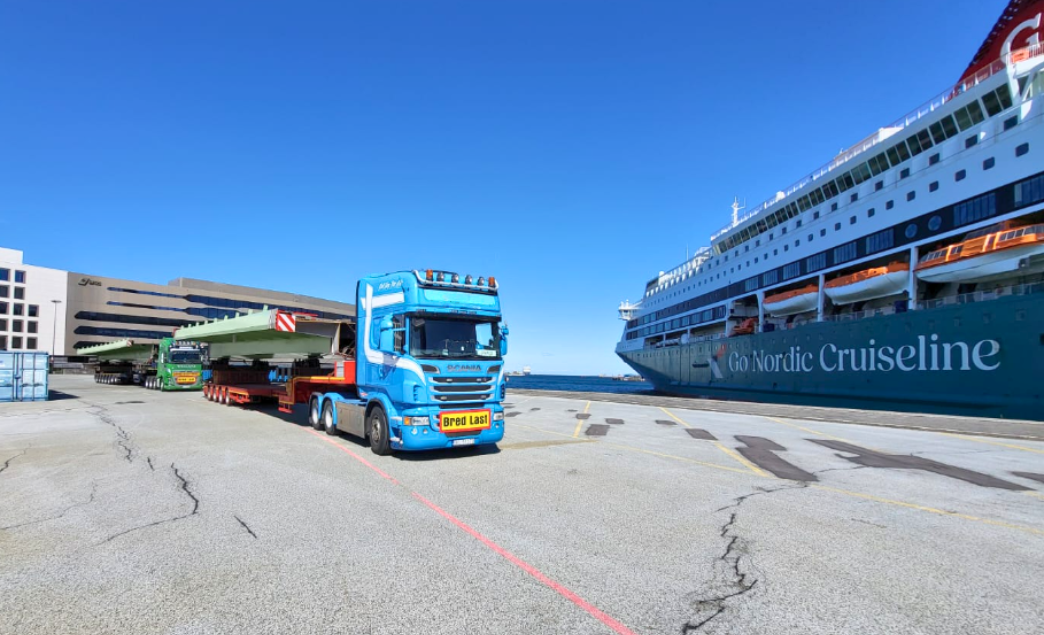
Visline Special Operation: How Do You Fit a 200-Meter Bridge onto Trucks? [case study]
-

07 May 2026
International transport UK-EU-UK: A complete guide to procedures, systems, and documentation in 2026.